

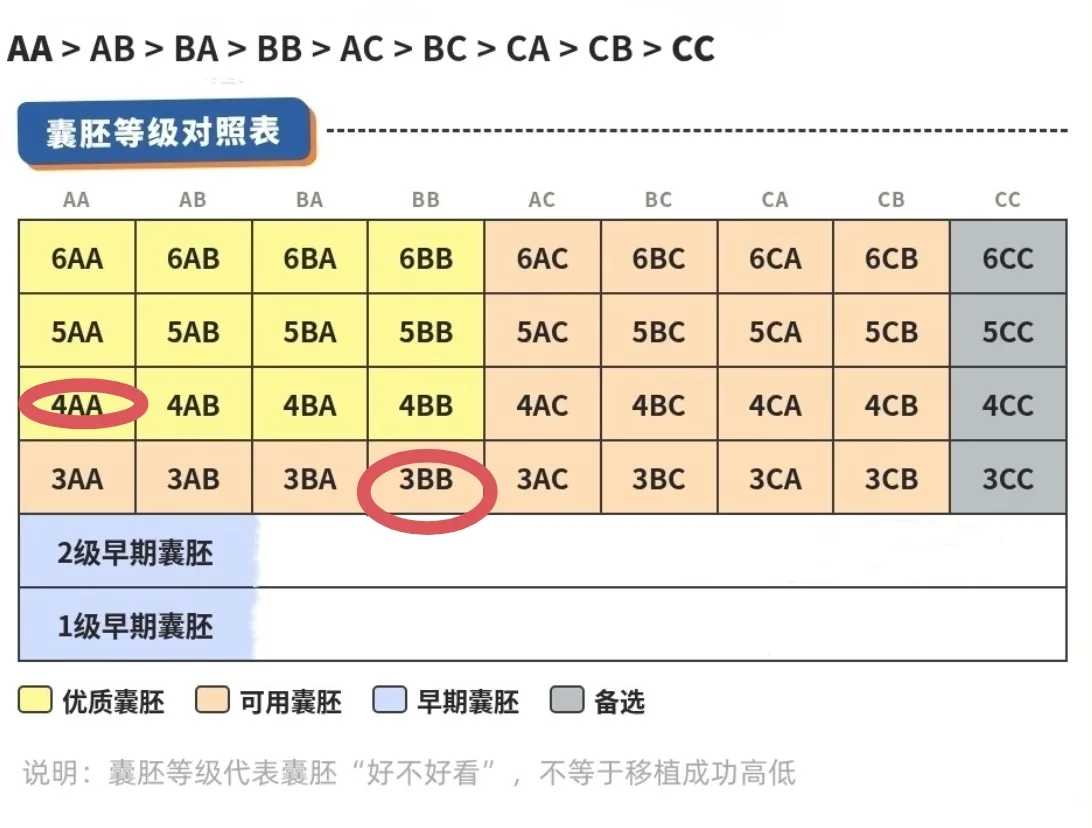
The numbers indicate the degree of expansion. The two letters represent respectively the inner cell mass and the trophoblast. The grade is merely a morphological assessment and does not indicate chromosomal normality.
Blast grading usually consists of three characters, such as 4AA.
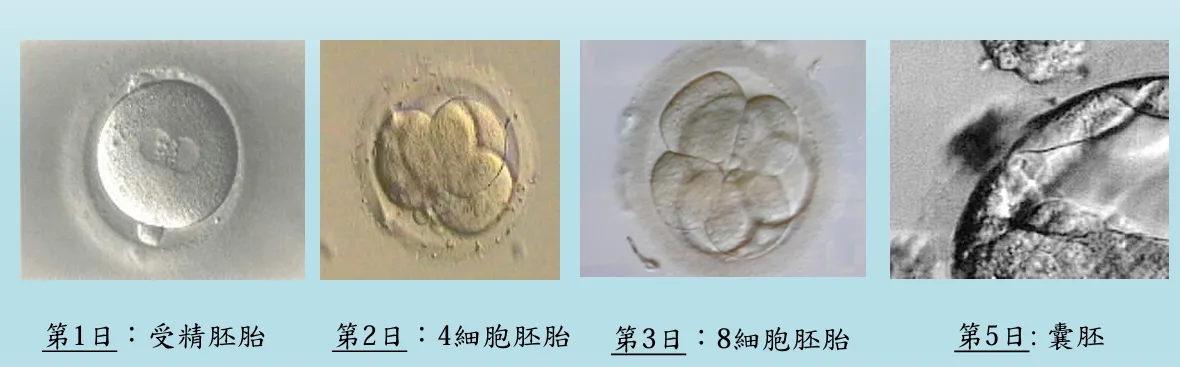
The first number (1-6) represents the degree of expansion: 1-2 indicates an early blastula, 3 indicates complete expansion, 4 indicates thinning of the zona pellucida after expansion, 5 indicates embryo hatching, and 6 indicates fully hatched embryo.
The first letter represents the inner cell mass (the part that will develop into the fetus): A indicates a large and dense group of cells, B indicates a smaller or less dense group of cells, and C indicates a very small group of cells.
The second letter represents the trophoblast (the part that will develop into the placenta). The grading system is the same as for A/B/C.
So, 4AA means "expanded stage + excellent inner cell mass + excellent trophoblast". 4AB indicates only slightly weaker trophoblast. Both are considered high-quality blastulas. 3BB falls into the upper middle category, with still a reasonable chance of pregnancy.
Two points to note: First, morphological assessments cannot determine chromosomal normality; only PGT can provide such information. Second, different laboratories may have different grading standards, so comparisons across institutions are not very meaningful.
After receiving the report, it's important to ask questions like: How many blastulas were obtained in this round? Were any screenings performed? Which blastula the doctor recommends for transplantation, and why?
For more on fertility preparation, second/third-generation IVF, and overseas, U.S., Thailand, Malaysia, America or Cambodia IVF, scan the QR code on the right or call lelaiwa's hotline+852 6145 8043!
 Address: Beijing City Yili Ecological Plaza
 WeChat: lelaiwa2008
 Phone: +852 6145 8043
